Hot Water Cylinder Guide: Types, Sizes & Signs Yours Needs Attention
What a hot water cylinder actually is, which systems use one, how capacity is worked out for a household, and the signs that tell you it is time to have yours looked at.
Understanding the cylinder in your home.
What is a hot water cylinder?
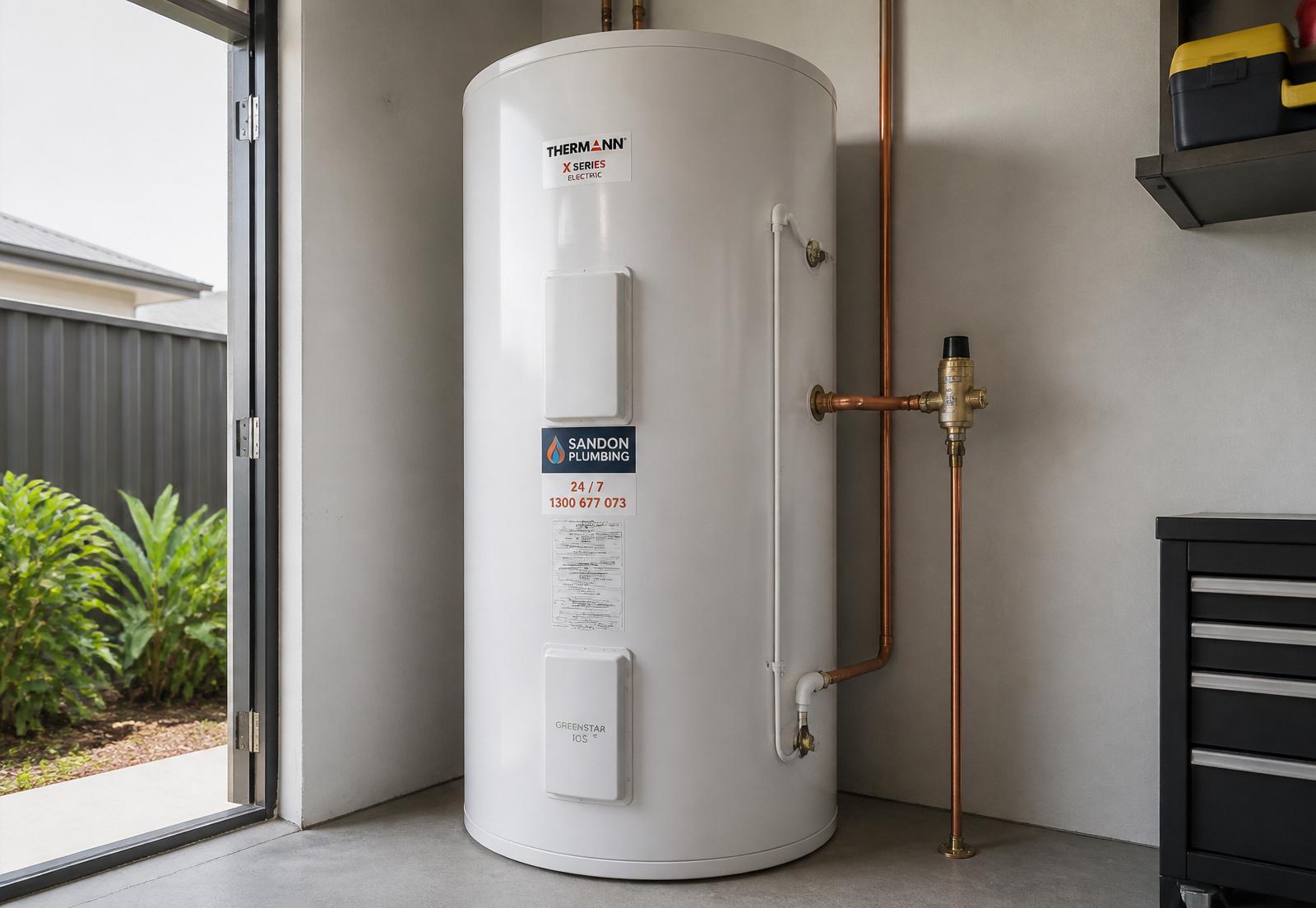
A hot water cylinder is the insulated vessel that heats water and holds it, ready for whenever someone in the house turns on a hot tap. Water is drawn in cold, brought up to the set temperature by an element, gas burner, heat pump or solar collectors, and then kept warm until it is used. When you empty the cylinder faster than it can reheat, you run out of hot water — which is why the size of the vessel and the speed it recovers both matter.
Australians use several words for the same thing. Hot water cylinder, hot water tank and storage hot water system are used more or less interchangeably in conversation, in manufacturer literature and in government guidance. If you have been searching one term and finding another, they are describing the same piece of equipment.
The important distinction is not between the words but between two ways of producing hot water. A storage system heats water in advance and keeps it hot in a cylinder. A continuous flow (also called instantaneous) system heats water only as it passes through the unit, so there is no stored volume and no cylinder at all. If your unit is a compact box on an external wall with no tank beneath it, you almost certainly have continuous flow, and most of what follows about cylinders will not apply to your home.
Common types of hot water cylinders
A cylinder is not a system in its own right — it is the storage part of one. Four common system types include a cylinder, and each heats the stored water differently.
Electric storage
A familiar arrangement in Australian homes. One or two electric elements sit inside the cylinder and heat the stored water to a thermostat setting. Tanks may be indoors in a cupboard or laundry, or outdoors against a wall. Because the heating is straightforward and the parts are widely stocked, these systems are simple to live with and simple to service — see the electric hot water page for how they are set up and maintained.
Gas storage
A gas burner beneath the cylinder heats the stored water, with a flue carrying combustion gases away. Gas storage typically recovers faster than a comparable electric element, which can suit households with concentrated morning demand. Where natural gas or LPG is available, this remains a practical option — the gas hot water page covers the differences in more detail.
Heat pump
A heat pump uses a refrigeration cycle to move heat from the surrounding air into the stored water, rather than generating heat directly. Some models are integrated, with the compressor mounted on top of the cylinder as a single outdoor unit. Others are split, with the compressor separate from the tank, which can help where space or noise placement is a consideration. Performance and suitability vary by model and by the conditions the unit is asked to operate in, so the heat pump hot water page is worth reading before you commit.
Solar
Solar hot water pairs roof-mounted collectors with a storage cylinder. Depending on the design, the cylinder sits on the roof beside the collectors (close-coupled) or at ground level with a pump circulating water (split). Because solar input varies with the season and the weather, these systems include a boost — electric or gas — to keep the stored water usable through cloudy or cold stretches. The solar hot water page sets out how the two parts work together.
Continuous flow systems are the odd one out: they have no storage vessel, so cylinder questions such as capacity, anodes and stored-volume recovery simply do not arise.
What size hot water cylinder does a household need?
There is no single number that fits every home, and any table that claims otherwise is being tidier than reality allows. Correct capacity is a balance between how much hot water your household draws at its busiest moment and how quickly your system can put heat back into the tank. Several factors feed into that.
- Number of occupants — the baseline, but rarely the whole answer on its own.
- Shower and bath habits — long showers, or a deep bath most nights, shift the requirement upward.
- Simultaneous demand — two showers running at once is a different problem to the same volume spread across a morning.
- System type — gas, electric, heat pump and solar all put heat back into the cylinder at different rates.
- Recovery rate — a smaller cylinder that reheats quickly can outperform a larger one that does not.
- Installation space — cupboard dimensions, external clearances and access can rule out larger vessels.
- Heating schedule — where an electric system heats on a controlled or off-peak arrangement, the tank must carry the household through the hours it is not heating.
That last point matters more than most people expect. If a cylinder is only energised for part of the day, its stored volume has to cover the entire period in between — so the right size on a continuously heated tariff can be undersized on a controlled one, with nothing else about the household changing.
The practical approach is to size for the peak half-hour rather than the daily average, then check that the chosen unit physically fits the space and the connections available. That assessment belongs to the particular household and the particular system, which is why we look at the site before recommending a capacity rather than quoting a figure over the phone.
Signs a hot water cylinder may need attention
Cylinders rarely fail without warning. The signals below are the ones a homeowner can genuinely observe — none of them identifies the fault by itself, but each is a reason to have the system looked at rather than waited out.
- Visible water around the base of the cylinder, or damp ground and staining underneath it.
- Rusty or discoloured hot water that clears when you run the cold tap.
- Hot water that runs out sooner than it used to, or that arrives inconsistently.
- Water that fluctuates between hot and lukewarm during a single shower.
- Rumbling, banging or hissing from the unit that was not there before.
- Corrosion, weeping or mineral crust around fittings, valves and pipework at the tank.
- A hot water circuit breaker that trips repeatedly, or a pilot that will not stay lit.
- An older system that has needed attention more than once in a short period.
What none of these tell you is why. Reduced hot water can come from an element, a thermostat, a heating schedule change, sediment or a failing cylinder, and the same symptom points to different causes on different system types. That is a job for an on-site look rather than a remote guess — our hot water repairs page explains how the fault is confirmed, and the common hot water problems guide walks through symptoms and their usual causes. If you have no hot water at all right now, start with the no hot water troubleshooting guide for the safe checks worth making first.
How long does a hot water cylinder last?
It would be convenient to give one number, but service life genuinely varies. Two identical-looking cylinders in two homes can reach very different ages depending on the manufacturer and model, how the cylinder is constructed and lined, the quality of the original installation, local water conditions, how consistently maintenance has been carried out and how heavily the household uses hot water.
Construction matters most. Many storage cylinders are steel with a vitreous-enamel (glass) lining, and that lining is protected by a sacrificial anode — a rod of more reactive metal that corrodes in place of the tank wall. It is doing its job precisely by deteriorating, which means it is a consumable rather than a permanent part. Stainless steel cylinders work on a different principle and do not rely on an anode in the same way.
Anode inspection and replacement requirements differ by brand and model, and some warranties tie their terms to that servicing being carried out. Rather than applying a blanket interval to every system, check the manufacturer's guidance for your specific unit — the compliance plate on the side of the tank carries the model and build details you need. Following that guidance is also the reliable way to keep warranty cover intact.
Repairing versus replacing a cylinder
Whether a cylinder is worth repairing depends on what has actually failed, the condition of the vessel itself, the age of the system, whether parts remain available for that model, and how the cost of the repair compares with the cost of replacing the unit outright. Component faults on a sound cylinder are often economical; problems with the vessel itself change the picture entirely.
Because this question deserves more than a paragraph, we have covered it properly elsewhere:
- Read our full Repair or Replace? guide for how the decision is actually made.
- See our Perth hot water replacement cost guide for what moves the price of a new system.
Repair or Replace? guide · Perth hot water replacement cost guide · hot water replacement service
Perth considerations
Perth is warm and sunny for much of the year with generally mild winters, which is friendly territory for hot water systems in general. Solar and heat pump systems both benefit from the amount of sun on offer, and mains gas is available in many Perth suburbs, giving households a genuine choice of system type.
Electric storage remains common across Perth and suits a wide range of housing: it is simple, widely serviced and straightforward to replace like for like. Where a household heats on a controlled or off-peak arrangement offered by their retailer, the stored volume has to carry the home through the non-heating hours, so tariff and heating schedule are part of the sizing conversation rather than an afterthought.
Heat pumps can work well in Perth conditions, but suitability is model-specific. Outdoor clearance for airflow, condensate drainage and noise placement relative to bedrooms and neighbours all vary between products. It is worth confirming that a particular model is appropriate for a particular site rather than assuming the category will suit.
Solar hot water suits Perth's sunny climate well, though performance still varies with the season and with cloud cover, which is why these systems include a boost. Understanding how and when the boost operates is part of understanding what the system will do for you across a full year.
When should you call a professional?
Some situations should not wait. Call a licensed professional if you can see water leaking from or pooling around the cylinder, if you have lost hot water entirely, if there is visible corrosion at the tank or its fittings, if a hot water breaker keeps tripping or a gas appliance will not stay alight, or if you are unsure what capacity and system type your household actually needs.
There are sensible checks you can safely make first — looking at the switchboard, confirming a gas supply is on, reading an error code on a controller, checking the ground beneath the tank. Beyond that, hot water work is regulated: opening a thermostat cover, touching gas components, working on a heat pump's sealed refrigerant circuit or altering pipework and electrical connections is licensed work, and attempting it is both unsafe and likely to void your warranty. We have deliberately not published step-by-step instructions for any of it.
If you would like the system assessed properly, get in touch and we will look at what you have, tell you plainly what condition it is in, and set out your options with a price before any work is agreed.
Tell us what's happening
Answer a couple of quick questions so we can get your hot water sorted.
Prefer to speak now? Call 08 6245 5556
Hot water cylinders, answered.
Is a hot water cylinder the same thing as a hot water tank?
+
In everyday Australian use, yes. 'Hot water cylinder', 'hot water tank' and 'storage hot water system' all describe an insulated vessel that heats and holds water ready for use. Continuous flow (instantaneous) systems are the exception — they heat water on demand and have no cylinder at all.
Do heat pump and solar systems have a cylinder?
+
Both store hot water, so both include a cylinder. Heat pumps come as integrated units, where the compressor sits on top of the tank, or split systems, where the compressor is separate. Solar systems pair collectors with a storage cylinder and a boost source for low-sun periods.
What size cylinder does my household need?
+
It depends on occupants, shower and bath habits, how much hot water is drawn at the same time, the system type and its recovery rate, the space available and, for electric storage, the heating schedule on your tariff. Sizing is worked out for the specific household rather than from a single universal rule.
What is a sacrificial anode and why does it matter?
+
Many vitreous-enamel (glass-lined) steel cylinders contain a sacrificial anode that corrodes in place of the tank wall. It gradually deteriorates as it does its job. Inspection and replacement requirements vary by manufacturer and model, so follow the guidance for your specific unit rather than a blanket interval.
Is rusty hot water a sign the cylinder is failing?
+
It can be, particularly when the discolouration appears only on the hot side and clears on the cold. It can also point to other causes, so it warrants an on-site look rather than a remote diagnosis.
Can a leaking cylinder be repaired?
+
Leaks at valves, unions and pipework are frequently repairable. Water coming from the cylinder body itself is a different matter, because the vessel is pressurised and cannot be safely patched. Which applies to your system can only be confirmed by inspection.
Keep reading
Not sure what condition your cylinder is in?
We'll inspect the unit on site, tell you what we find, and explain the options — service, repair or replacement — with a price before anything is agreed.
- Same-day service where available
- Fixed-price quotes before work starts
- Licensed and insured
- All major brands serviced
Servicing Perth, Mount Lawley, Subiaco, Scarborough, Joondalup, Fremantle and Rockingham.
Want your cylinder assessed?
Tell us the system type and what you're seeing — we'll give you a straight answer.